-
Demo Post and What is to Come
Hello and welcome to my Blog! Most of this will act as a documentation repository for my projects (both physical and digital). The physical projects will have documentation, assembly guides and a link to where you can get the files (if appliciable). The digital projects will focus more on acting as dev-logs updating the viewer…
-
Make a Line
For my final project for my alternative arcade class, I made a game based on the principles of series and parallel voltage calculation. The game itself was made in the game coding framework “Raylib”, while the controller is a Arduino pro micro spoofing a keyboard. Game Play There are three main sections, the target, the…
-
A Shocking Pong Clone
As an intro to my Alternative Arcade Controls class, each person was tasked with making a pong clone that utilized a unique controller scheme. I decided to tie my pong game’s design to sticking a fork in an outlet to move the ball up and down. Many issues have been faced during this project, and…
-
Final Comp Fab Project
The final project in my computational fabrication class is a self-study project where a form of computation will be used to fabricate the design. In my case, I will be creating a print-in-place hinge based FDM printed fabric. As always, the codes on my GitHub, under the name “TriangleFabric” 1 & 2. The Concept Create…
-
Travel Through Another Dimension
Additive manufacturing in 2024 can be done through multiple different processes. In this blog post, we will be focusing on the process of FMD/FFM printing. FDM/FFM uses a roll of filament as the material that is extruded through a hot end of a printer to make lines that can build upon each other. This post…
-
A Seat at the Table
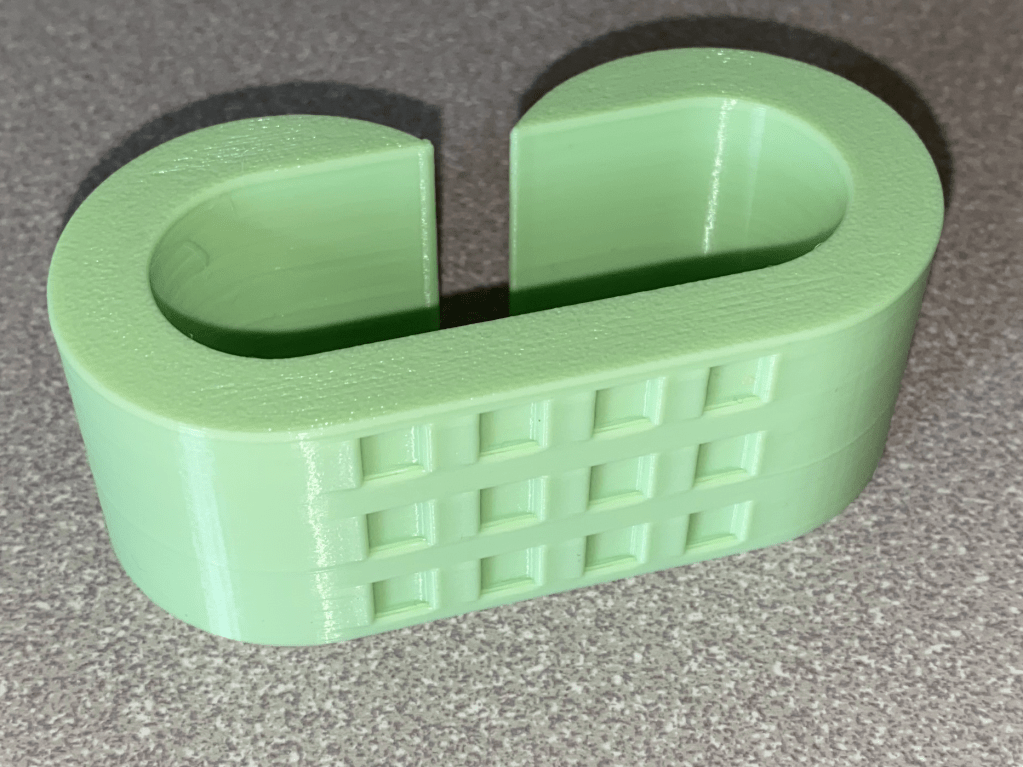
Additive manufacturing allows for amazing geometries that cannot be created through traditional means. There are also distinct traits of the available methods of additive manufacturing currently, namely layer lines. These lines allow for strong tensile strength perpendicular to the lines, and weak strength when a parallel force is applied. Task 1: Digital Design The design…
-
Stacking Up
A common use of fabrication techniques is to turn a modeled 3D object file into something existing in physical space. This task of making a 3D file readable for the manufacturing process is known as “slicing” a model. This Post will go over the process of creating a parametric 3D model and then slicing it…

-
L-Systems
L-Systems originated from the observations of micro flora growth patterns. The patterns allowed for forms of symmetry and growth through the use of rules. The L-Systems used in this post will utilize two main parts: the vocabulary and the axiom. The vocabulary is the apparent commands and the rule on iteration involving them. The Axiom…
-
Working With Lasers! (M2 Lasered!)
For this Comp Fab assignment, I had to design three different designs using code that utilize the three main methods of laser cutting; Laser engraving/etching, vector line marks and the standard laser cut. Etching moves the laser across a designated area at fast speeds to leave a burned mark, but not much depth. laser vector…
-
“Seeing is Believing” Examples of Computational Design
To further develop an understanding for what computation fabrication means and how it is used in day to day life. Examples of computational designs will be observed and commpented upon. There are three main sections to this post: naturally occuring computational design, human made computation designs, and some of the people within the computational fabrication…
-
Subscribe
Subscribed
Already have a WordPress.com account? Log in now.
 Quincy's Projects